
The Physics of Underfoot Thermodynamics in Winter Footwear
Designing professional-grade winter hiking boots requires a deep, scientific understanding of wilderness thermodynamics and biomechanical stress. When a hiker navigates frozen alpine trails or ice-covered valleys, the most significant and persistent thermal threat does not necessarily come from the ambient freezing air. Instead, the greatest danger of heat loss stems directly from the solid ice, snow, and frozen earth beneath their feet. The soles of the boots are in constant, high-pressure contact with this frozen ground, creating a continuous physical bridge for rapid conductive heat loss. If this downward thermal leak is not aggressively mitigated, even the thickest, most technologically advanced upper materials will fail to keep the wearer’s core temperature stable.
To combat this relentless ground-up freezing effect, footwear designers, product directors, and outdoor enthusiasts rely heavily on specialized internal components. While the outer shell of the boot—typically composed of premium leather or vulcanized rubber—receives the majority of consumer marketing attention, the internal footbed is arguably the most critical thermal barrier in the entire footwear system. Designing or sourcing high-performance insulated inserts for boots is often the determining factor in a product’s overall laboratory warmth rating and real-world success. Today, the B2B manufacturing debate over the best materials for these critical underfoot components largely centers on the historic performance of natural wool versus the modern engineering of synthetic alternatives.
The Structural Vulnerability of Natural Wool Felt

Natural wool has been a foundational staple in mountaineering, military, and outdoor footwear for centuries. In the specific context of underfoot protection, boiled wool or densely compressed wool felt is frequently used to construct heavy-duty insoles. The enduring appeal of natural wool lies in its complex biological fiber structure, which contains thousands of microscopic crimps. These natural crimps create tiny pockets of dead air that act as a buffer between the warm sole of the foot and the freezing midsole of the boot, providing excellent initial thermal resistance when the boot is first put on.
Additionally, wool boasts an impressive biological capacity for managing early-stage moisture in cold environments. It can absorb a significant percentage of its own weight in sweat vapor before the hiker ever begins to feel dampness against their skin. However, when deployed specifically as an underfoot barrier, natural wool faces a massive mechanical disadvantage. A hiker carrying a heavy, multi-day expedition backpack exerts massive downward pressure with every single step, driving their heel and metatarsals into the footbed. Over miles of rugged terrain, this relentless pounding permanently flattens the delicate biological structure of the wool fibers. Once the natural crimp is crushed under this weight, the insulating dead air escapes, and the once-protective wool felt rapidly transforms into a highly conductive, cold pathway.
Moisture Management and the Limits of Synthetic Foams
To address the severe mechanical compression and heavy moisture-retention issues associated with natural fibers, the outdoor footwear industry introduced synthetic insulation materials. In the realm of footbeds and removable inserts, this typically takes the form of dense polyester fiber-fills, EVA (ethylene-vinyl acetate) foams, or closed-cell polyurethane pads. The primary and most heavily marketed advantage of these synthetic materials is their inherent hydrophobicity. Unlike wool, which absorbs and holds onto heavy water, synthetic fibers and foams naturally repel liquid. If snow breaches the collar of the boot, or if the foot sweats profusely during a steep climb, synthetic materials will dry exponentially faster than their natural counterparts.
Despite this crucial moisture-management advantage, traditional synthetic materials still struggle to survive the extreme physical demands of a hiking boot’s interior chamber. Polyester batting relies on the exact same loft-based physics as wool; it must remain fluffy to trap convective air. When subjected to the weight of a heavy hiker, it flattens just as quickly as wool felt, permanently losing its thermal efficacy. Conversely, closed-cell foams resist physical compression much better, but they introduce a new problem: they are entirely impermeable to water vapor. This creates a solid vapor barrier directly under the foot, trapping sweat inside the boot and accelerating conductive heat loss through the resulting internal moisture buildup.
Engineering High-Performance Insulated Inserts for Boots
Given the severe mechanical vulnerabilities of both lofted wool and traditional synthetic batting, footwear developers are fundamentally rethinking how to protect the plantar surface of the foot. The engineering solution is no longer about adding thicker, bulkier materials that will inevitably compress, flatten, and fail over the course of a long wilderness trek. Instead, the focus has shifted entirely toward engineering advanced insulated inserts for boots that utilize completely different physical principles to block conductive ground chill.
The modern footwear engineering approach requires a material that is exceptionally thin to preserve the anatomical fit and spatial geometry of the shoe. It must be highly resistant to weight-bearing compression and fully capable of dynamic moisture transport. When manufacturers integrate advanced, thin-film thermal barriers directly into the strobel board assembly or the removable insole system, they create a uniform, impenetrable shield across the entire bottom of the foot. This high-tech barrier stops cold transfer from the icy ground without relying on fragile pockets of trapped air that are destined to collapse under the pressure of a human stride.
Y-Warm: Space-Age Nanoporous Physics for Modern Footwear
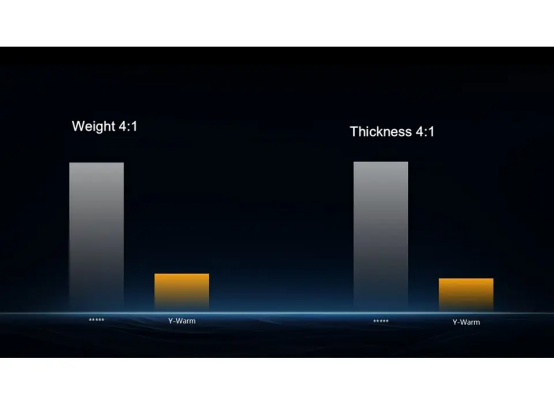
At the absolute forefront of this structural footwear revolution is Y-Warm, an advanced material developed by Beijing Y-Warm Technologies Co., Ltd. Instead of mimicking the air-trapping loft of down or wool, Y-Warm fundamentally alters the physics of heat transfer. It utilizes a highly flexible, proprietary nanoporous membrane. This revolutionary structure completely overcomes the physical brittleness typically associated with aerogel technologies, bringing space-age thermal retention directly into commercial footwear manufacturing.
For technical footwear engineers, Y-Warm offers unparalleled performance metrics that traditional materials simply cannot match. Measuring just 0.7 millimeters in thickness, it can be seamlessly integrated into insulated inserts for boots without crowding the toe box or requiring costly modifications to the shoe’s internal volume. Despite its ultra-thin profile, it boasts an incredibly low thermal conductivity. Because it is a continuous nanoporous sheet, it does not rely on loft, meaning it does not lose its thermal resistance when subjected to heavy, repetitive compression.
Furthermore, Y-Warm elegantly resolves the critical issue of trapped underfoot moisture that plagues synthetic closed-cell foams. While the material is completely windproof and cold-impermeable, it features built-in hydrophilic groups that make it highly water-vapor permeable. It actively absorbs sweat vapor from the sole of the foot and transports it outward, ensuring that the hiking boot remains dry, comfortable, and thermally secure throughout the longest and most demanding winter wilderness expeditions.
Beijing Y-Warm Technologies Co., Ltd. is a global pioneer in advanced material science, committed to replacing bulky, outdated insulation with ultra-thin, high-performance physical barriers. Our globally patented Y-Warm insulation fabric is EU SVHC (REACH) compliant and Oeko-Tex Standard 100 certified, offering B2B partners a highly sustainable, premium solution for modern footwear design. Whether you are developing lightweight trail runners, tactical workwear, or heavy-duty mountaineering gear, discover how our revolutionary technology can redefine your next collection. We invite product directors and supply chain managers to explore our dedicated applications and request a professional material sample kit today at Y-Warm Shoes.
