
In vegetable oil refining, deodorizer distillate and soapstock have traditionally been treated as low-value byproducts – sold as biodiesel feedstock or industrial fatty acids. However, these byproducts contain two valuable resources for the animal feed industry: phytosterols and lipids that can be upgraded by lipases.
Ocean has designed and built over 200 oil refining lines globally. Based on this experience, we help clients extract phytosterols from deodorizer distillate and use lipase technology to convert byproduct oils into high-performance feed ingredients. This article explains how these technologies create new revenue streams for feed processors and refiners alike.
Part 1: Phytosterols – A Valuable Feed Additive from Deodorizer Distillate
What Are Phytosterols?

Phytosterols are naturally occurring sterol compounds found in vegetable oils. Common phytosterols include β-sitosterol, stigmasterol, and campesterol. During physical refining, these sterols are stripped together with free fatty acids and become concentrated in the deodorizer distillate.
Typical phytosterol content in deodorizer distillate ranges from 8–20%, depending on the crude oil source. This represents a significant resource that is often discarded or burned.
Feed Value of Phytosterols
Research and commercial applications have demonstrated several benefits of phytosterols in animal feed:
- Improved growth performance – Studies show that adding 80–120 ppm phytosterols to broiler feed increases daily weight gain by 5–8% and improves feed conversion ratio.
- Reduced feed cost – Phytosterols competitively inhibit cholesterol absorption, partially replacing the need for added fat sources in feed formulations.
- Immune modulation – Phytosterols have anti-inflammatory properties, helping reduce disease incidence and the need for antibiotics.
- Product quality enhancement – By improving lipid metabolism, phytosterols can increase the proportion of unsaturated fatty acids in meat and eggs.
How Ocean Recovers Phytosterols
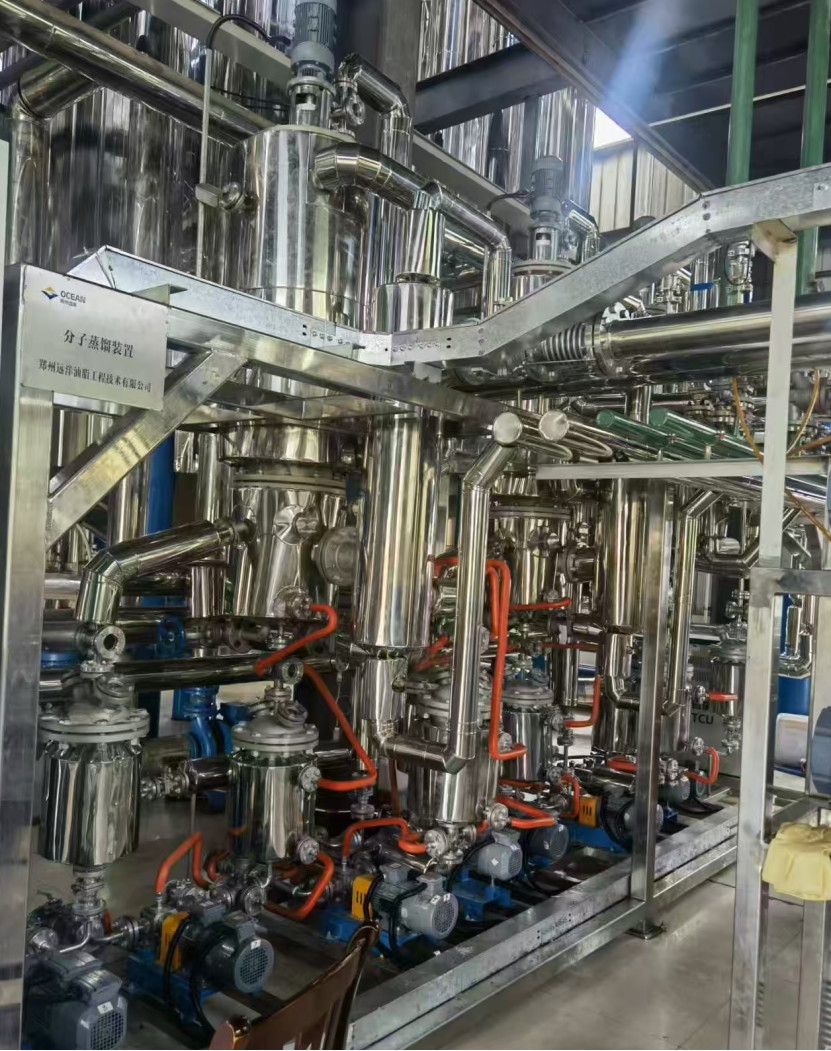
Phytosterol recovery from deodorizer distillate is achieved through molecular distillation – a low-temperature, short-residence-time separation technology that preserves heat-sensitive compounds.
Ocean’s tocopherols, carotene & phytosterols extraction plant includes a dedicated phytosterol recovery module with three steps:
Step 1: Esterification – Free fatty acids in the distillate are esterified with methanol or ethanol under mild conditions, converting them into fatty acid esters. This step separates the fatty acids from the sterols.
Step 2: Molecular distillation – Under ultra-high vacuum (0.001–0.01 mbar), phytosterols are evaporated and condensed separately from fatty acid esters and other components.
Step 3: Crystallization – Crude phytosterols are further purified by solvent crystallization to achieve 90–95% purity, suitable for feed additive applications.
Economic Value
For a 100 TPD vegetable oil refinery, deodorizer distillate output is approximately 0.5–1.0 TPD. At 10% phytosterol content and 85% recovery, daily phytosterol production is about 40–85 kg.
At a feed-grade price of USD 5–8 per kilogram, annual phytosterol revenue (300 days) ranges from USD 60,000 to 200,000 – turning a waste stream into a significant profit center.
Part 2: Lipases – Enhancing Digestibility of Byproduct Oils
Why Byproduct Oils Need Enzyme Treatment
Soapstock and acid oil – byproducts of the chemical refining process – contain significant fat resources. However, they have several problems that limit their use in animal feed:
- High free fatty acid content (40–70%) – FFA is absorbed less efficiently than triglycerides
- Partial glycerides and impurities – Further reduce digestibility
- Poor palatability – Affects feed intake
Untreated acid oil provides only 60–70% of the metabolizable energy of refined oils when added directly to feed.
How Lipases Solve the Problem
Lipases are enzymes that catalyze the hydrolysis of triglycerides into free fatty acids and glycerol. In byproduct oil upgrading, lipases serve two functions:
Function 1: Complete hydrolysis – Under controlled conditions (pH 7.0–8.0, 40–55°C), lipases convert residual triglycerides and partial glycerides into free fatty acids and glycerol. The resulting product has more consistent composition and can be further processed into distilled fatty acids.
Function 2: Feed additive – When added directly to feed formulations, lipases continue to work in the animal’s digestive tract, breaking down fats more efficiently and improving nutrient absorption.
Process Integration
Ocean integrates lipase treatment into the byproduct processing line as follows:
- Soapstock or acid oil is first neutralized and adjusted to optimal pH.
- Liquid lipase preparation is added in a controlled reaction vessel.
- The mixture is held at 40–55°C for 4–12 hours, depending on feedstock quality and target products.
- Glycerol and fatty acids are separated by gravity or centrifugation.
- The fatty acid fraction can be sold directly or further distilled.
Economic Benefits
For a facility processing 10,000 tons per year of acid oil, the value uplift from enzymatic treatment is substantial. Digestibility increases from 65–70% to 80–85%, and the product can be sold as distilled fatty acid at a premium over untreated acid oil.
Annual value increase typically ranges from USD 1.5 to 2.0 million, with enzyme costs representing about 10–15% of the added value.
Part 3: Combined Value – A Complete Byproduct Utilization Strategy
When phytosterol recovery from deodorizer distillate is combined with lipase treatment of soapstock and acid oil, the refinery achieves full byproduct utilization:
- Deodorizer distillate → molecular distillation → phytosterols (feed grade) valued at USD 5–8/kg
- Soapstock/acid oil → lipase hydrolysis → high-digestibility fatty acids valued at USD 600–700/ton
- Residual streams → esterification → biodiesel feedstock at USD 400–500/ton
Environmental benefits are equally significant:
- Reduced wastewater COD load (fatty acids are recovered, not discharged)
- Lower solid waste disposal costs
- Improved overall carbon footprint
Conclusion
Oil refining byproducts are not waste – they are resources waiting to be unlocked. Phytosterols recovered from deodorizer distillate provide a valuable feed additive that improves animal growth performance. Lipase treatment of soapstock and acid oil converts low-digestibility byproduct oils into high-quality fatty acid products for feed formulations.
Together, these technologies transform the refinery’s byproduct management from a cost center into a profit center.
Ocean’s tocopherols, carotene & phytosterols extraction technology includes phytosterol recovery capabilities, and our byproduct processing lines integrate lipase treatment where beneficial.
For more detailed process information, equipment specifications, or a customized ROI analysis for your facility, please visit Ocean or contact our engineering team directly.
