
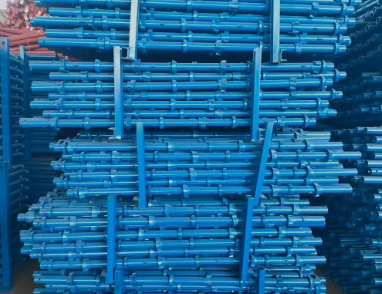
Modern skyscraper developments and large-scale infrastructure projects place extreme physical demands on temporary structural support framework. Vertical building designs require robust modular assemblies that maintain rigid verticality while enduring unpredictable atmospheric conditions and elevated live loads.
High-tensile steel scaffolding serves as the primary load-bearing matrix, transferring vast dynamic weights down to primary ground foundations during complex civil engineering operations. Selecting the correct metallurgical grade and modular arrangement directly influences construction timelines and jobsite worker safety protocols across major infrastructure builds. Specialized supply partners such as Rongze provide heavy-duty modular components tailored to these demanding engineering criteria, supporting complex civil works worldwide.

Structural Interlocking Systems for Modular Frameworks
Connecting individual structural members securely represents a fundamental challenge in complex civil engineering applications. Traditional coupler setups rely strictly on friction resistance created by hand-tightened bolts, introducing potential human error into critical structural joints. Modern modular systems utilize engineered node connections that lock horizontal ledgers and diagonal braces into fixed vertical standards through mechanical wedging action.
Among these advanced connection designs, the Ringlock steel scaffolding utilizes a heavy-duty central rosette welded at fixed intervals along vertical standards. Inserting captive wedge pins into rosette keyholes creates a rigid 90-degree mechanical joint capable of bearing substantial multi-directional forces. This self-aligning geometry simplifies structural assembly on complex elevated bridges, dams, and high-rise perimeters while maintaining precise dimensional tolerances.
Rigid joint geometry minimizes spatial movement within the overall framework, significantly reducing structural swaying under heavy traffic or vibration. Automated manufacturing processes produce these locking components to tight dimensional tolerances, eliminating loose play within the node points. Consistent joint integrity preserves structural alignment, preventing progressive frame distortion across multi-story modular assemblies.
Metallurgical Composition and Environmental Resilience
Operating conditions in heavy infrastructure environments subject temporary equipment to aggressive atmospheric exposure, chemical contact, and abrasive handling. Unprotected carbon steel tubes react quickly with airborne moisture and oxygen, forming iron oxide layers that erode wall thickness over time. Subsurface infrastructure projects, such as marine piers and tunnel linings, expose metal frameworks to high humidity and corrosive salt environments that accelerate structural degradation.
Applying a hot-dip galvanized protective finish coats internal and external tube surfaces with a durable zinc-iron alloy layer. This metallurgical barrier shields the underlying steel core against harsh atmospheric elements, preventing internal corrosion that could otherwise weaken hidden load-bearing sections. Long-term corrosion resistance preserves nominal wall dimensions, allowing equipment to sustain high load capacities through multiple construction cycles.
Alternative surface treatments, including powder coatings or specialized painting, provide surface coloring but lack sacrificial zinc protection when scratched during transport. Deep gouges or mechanical abrasion break surface coatings, exposing bare steel to moisture infiltration and localized rusting. Investing in hot-dip galvanized components minimizes maintenance overhead while safeguarding structural capacity across demanding outdoor civil engineering applications.
Shoring Applications in Bridge and Tunnel Engineering
Civil infrastructure projects frequently require specialized shoring structures capable of supporting heavy reinforced concrete pours during curing stages. Massive bridge decks and subterranean tunnel arches generate extreme downward pressure that standard access frames cannot support alone. Modular heavy-duty shoring assemblies utilize reinforced vertical standards and heavy-duty screw jacks to hold massive concrete forms in exact position.
Accurate load distribution across the supporting foundation remains vital when installing heavy-duty shoring beds on soil or soft asphalt. Reinforced base plates paired with heavy screw jacks distribute concentrated axial forces across larger surface areas to mitigate soil settlement issues. Fine height adjustments on screw jacks allow engineering crews to achieve precise elevation control, compensating for subtle ground shifts during continuous concrete pouring operations.
Integrating diagonal bay bracing into shoring towers enhances lateral rigidity, enabling the temporary structure to resist sudden sway caused by concrete pumping surges. Standardized wedge connections enable rapid adjustment of bracing angles to accommodate varying pier heights and complex bridge geometries. Systematic shoring design provides stable temporary support until cured concrete structures achieve independent load-bearing capacity.
Standardization and Assembly Efficiency in Megaprojects
Managing large-scale infrastructure construction requires strict standardization across all equipment inventories and assembly workflows. Utilizing uniform modular components across different jobsite sectors eliminates site confusion, streamlines material handling, and reduces labor hours during installation sequences. Standardization allows engineering teams to deploy pre-calculated frame configurations without requiring custom field modifications or special structural adaptations.
Intuitive locking mechanics accelerate assembly sequences while minimizing installation errors by site personnel. Standardized node geometry ensures every diagonal brace and horizontal ledger registers at pre-engineered angles automatically. Clear visual locking indicators enable site supervisors to inspect structural connections rapidly, verifying that wedge pins are fully seated into rosette slots before approving elevated work areas.
Streamlined logistics management relies heavily on component interchangeability across expansive project sites. Modular components with uniform dimensional parameters simplify inventory tracking, storage stacking, and transportation scheduling. Efficient equipment management reduces jobsite downtime, enabling project managers to maintain strict operational schedules on high-density urban developments.
Structural Inspection Protocols and Safety Standards
Maintaining structural integrity across extended construction timelines requires rigorous, ongoing inspection and maintenance schedules. Daily site reviews focus on checking base jack stability, verifying tie-in integrity, and confirming that locking wedges remain tight within node connections. Environmental factors such as ground settling, high thermal expansion, or severe storms necessitate immediate structural re-evaluations before crews resume elevated work operations.
Non-destructive testing methods, including ultrasonic wall thickness checks and magnetic particle weld inspections, verify component health during routine factory maintenance turnarounds. Identifying micro-fissures, internal rust accumulation, or subtle tube bending prevents compromised components from re-entering active jobsite inventory. Rigorous quality control safeguards operational stability across high-stress infrastructure applications.
Sourcing structural components from an established scaffolding manufacturer ensures full compliance with international engineering codes and material standard specifications. Verified factory testing documentation gives site engineers absolute confidence in nominal yield strengths and allowable load ratings under dynamic field conditions. Adherence to strict manufacturing tolerances minimizes structural risks across multi-story access systems manufactured by Rongze.
Key Performance Factors in Structural Applications
Balancing high load-bearing capacity with modular flexibility determines the operational success of temporary framework on high-rise and infrastructure job sites. Utilizing high-grade carbon steel formulations paired with hot-dip galvanized surface finishes protects load capacity against severe environmental corrosion over extended deployment periods.
Mechanized connection nodes, such as wedge rosettes, establish rigid structural frameworks that absorb dynamic lateral forces while streamlining assembly workflows. Adopting standardized modular systems manufactured to rigorous international standards enables engineering teams to execute complex civil builds safely, efficiently, and with total structural confidence.
