
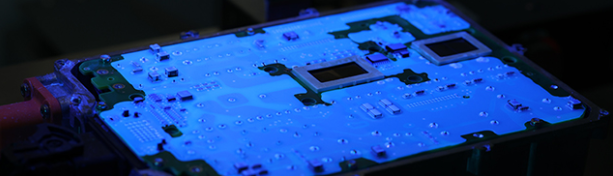
Automotive electronics must operate reliably despite vibration, temperature changes, moisture, and long service life. Automated fluid application helps protect sensitive circuits, secure components, and maintain repeatable assembly quality across high-volume production.
Properly configured conformal coating equipment can apply protective films along complex PCB layouts while controlling movement, coating paths, and process parameters. Axxonauto develops dispensing and coating automation for industrial applications, where stable material delivery and consistent motion are important to manufacturing quality.

How to Protect Electronic Components Against Harsh Conditions?
Modern vehicles rely on electronic control units, sensors, power modules, and driver-assistance systems. These assemblies may face humidity, dust, corrosive substances, and thermal cycling throughout their service life. Protective coatings create a barrier between sensitive circuitry and environmental exposure, helping reduce the risk of corrosion, leakage currents, and premature component failure.
The coating material must match the operating environment and the board design. Acrylic coatings can offer relatively straightforward application and rework, while silicone materials are often selected for flexibility across temperature changes. Urethane and other specialized formulations may suit applications with particular chemical or mechanical demands. Material selection should account for curing requirements, component compatibility, repair needs, and applicable automotive specifications.
Coverage matters as much as material choice. Connectors, test points, switches, and other areas may require masking or exclusion, while narrow spaces around components can be difficult to reach consistently. Automated paths help control where material is deposited, but engineers still need to verify coverage around edges, under component overhangs, and near areas that must remain uncoated.
| Coating material | Typical property | Consideration |
| Acrylic | Easy application and rework | Limited chemical resistance in some environments |
| Silicone | Flexibility across temperature changes | May require careful adhesion promotion |
| Urethane | Chemical and mechanical resistance | Curing and repair requirements |
How to Maintain Motion Accuracy and Repeatable Coating Paths?
Automotive PCB layouts vary in size, component density, and surface geometry. Manual application can introduce differences in film thickness and coverage between operators or shifts. Automated dispensing follows programmed paths, allowing engineers to define motion, dispensing timing, and application zones according to the board’s requirements.
Motion performance affects both productivity and coating quality. Excessive speed may create uneven coverage around corners or abrupt changes in direction, while unnecessarily slow movement can extend cycle time and increase material exposure. Acceleration, nozzle height, path overlap, and valve response should be evaluated together rather than adjusted independently.
The conformal coating process also depends on the interaction between the fluid and the substrate. Surface energy, viscosity, ambient temperature, and material condition influence wetting and film formation. A repeatable machine path cannot compensate for contaminated surfaces or unsuitable material settings, so process validation should include both equipment parameters and board preparation.
How to Balance Production Speed, Inspection, and Quality Control?
High-volume automotive assembly requires a balance between throughput and process stability. Cycle-time analysis should account for board loading, coating movement, material changes, curing, and inspection rather than focusing only on the machine’s maximum travel speed. A faster motion profile may provide limited benefit if it creates defects that require rework or additional inspection.
The MYC50 is a high-speed conformal coating machine designed for mass production, offering micron-level precision and X- and Y-axis travel speeds of up to 800 mm/s. It supports automated complex coating processes, process-parameter monitoring, and coating-pattern changes without interruption. These capabilities provide a basis for evaluating how motion performance and software control fit a specific automotive electronics line; actual results depend on board geometry, material behavior, and process settings.
Inspection helps confirm whether the programmed process produces the required result. Depending on the coating and board design, checks may examine coverage, thickness, bubbles, bridging, contamination, or unwanted deposits. Optical inspection can identify visible defects, while other measurement methods may be needed to assess film thickness or hidden areas. Recording results by production batch also helps engineers trace recurring problems to material, recipe, or equipment changes.
Conclusion
Automated dispensing supports automotive electronics assembly by making protective material application more consistent, repeatable, and measurable. Its value depends on a coordinated process: suitable chemistry, accurate motion, controlled application parameters, and inspection methods matched to the board’s requirements.
Environmental protection requirements deserve equal weight with cycle time, maintainability, and traceability when manufacturers assess conformal coating equipment. Axxonauto‘s automation technologies provide options for examining these requirements in practical production settings, where validated performance matters more than a single speed or precision specification.
FAQs
Why Is Automated Coating Important for Automotive Electronics?
Automated coating helps control material placement and coverage across repeated production cycles. This supports consistent protection against moisture, dust, and other environmental stresses when the material and process are appropriately selected.
Which Coating Materials Are Used in Automotive Electronics?
Common options include acrylic, silicone, and urethane formulations, along with other specialized materials. The appropriate choice depends on environmental exposure, flexibility, chemical resistance, curing conditions, and repair requirements.
How Does Motion Speed Affect Coating Quality?
Travel speed influences film formation, edge coverage, and cycle time. Engineers should validate speed alongside acceleration, nozzle height, valve timing, and material properties to identify a stable operating range.
What Should Be Checked After Automated Coating?
Inspection may cover film continuity, thickness, bubbles, unwanted deposits, and protected areas that should remain uncoated. The exact checks depend on the board design, coating chemistry, and applicable quality requirements.
How Can Manufacturers Evaluate a Coating System?
Assessment should include board compatibility, path accuracy, throughput, recipe flexibility, monitoring capabilities, maintenance requirements, and inspection results. A system’s suitability is best established through trials using representative products and production conditions.
