
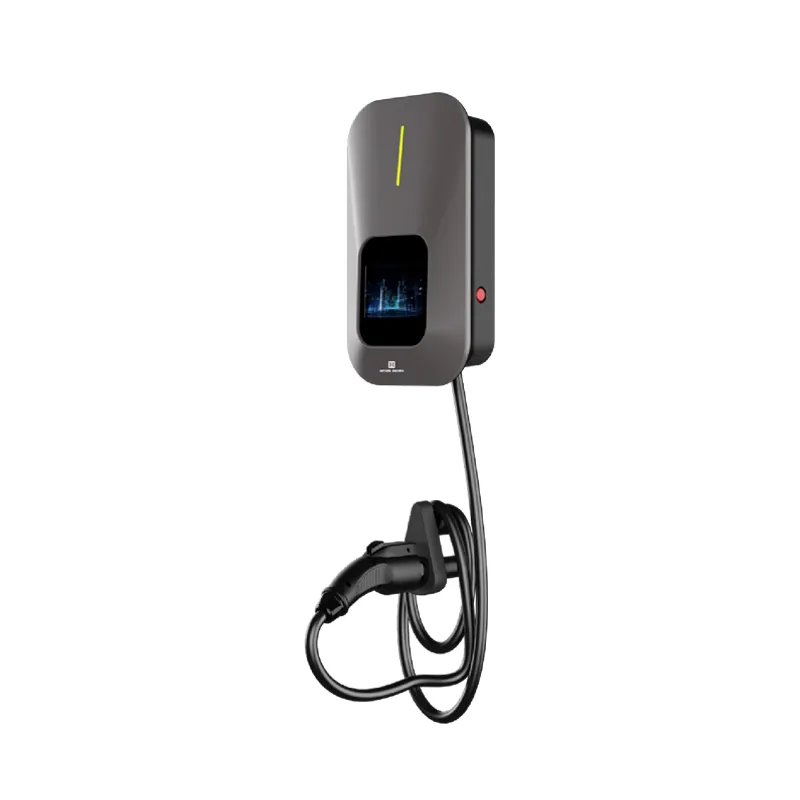
Commercial property developers, fleet operators, and workplace facility managers often face a fundamental choice when selecting EV charging equipment: should they install AC or DC units in a wallbox form factor. While both serve the same ultimate purpose—delivering energy to electric vehicles—the technical distinction and practical implications are significant.
Understanding the Core Technical Distinction

The primary difference between an AC charger and a DC wallbox EV charger lies in where the power conversion occurs. An AC wallbox supplies alternating current directly to the vehicle, relying on the car’s onboard converter to transform it into DC for battery storage. This limits charging speed to the capacity of the vehicle’s internal electronics—typically 7kW to 22kW. In contrast, a DC wallbox EV charger performs the AC-to-DC conversion inside the unit itself, delivering high-voltage direct current straight to the battery. This bypasses the vehicle’s onboard charger, enabling significantly faster charging speeds, often ranging from 60kW to 120kW or more in compact wallbox designs.
AC Wallbox: The Versatile Workhorse
INFORE ENVIRO‘s Vega series Commercial Wallbox exemplifies the benefits of AC technology. Available in 7kW, 11kW, and 22kW configurations, this wallbox EV charger supports both floor-standing and wall-mounted installation, making it suitable for homes, offices, commercial complexes, parking lots, and public stations. It offers multiple startup methods (APP, RFID card, plug-in charging) and networking options including 4G, WiFi, Bluetooth, and Ethernet. Safety features include overcurrent, short-circuit, leakage protection, and emergency shutdown. Smart functionalities such as scheduled charging, dynamic load balancing (DLB), remote upgrades, and remote diagnostics make it an ideal choice for locations where vehicles park for extended periods.
DC Wallbox: Speed for Time-Sensitive Operations
For applications where dwell time is limited—such as retail forecourts, highway service areas, and logistics depots—a DC wallbox EV charger provides the rapid turnaround that AC units cannot match. While AC chargers may require 4 to 8 hours for a full charge, a DC wallbox can deliver an 80% charge in 30 to 60 minutes. This speed advantage comes with higher equipment costs and greater electrical infrastructure demands, but for businesses prioritizing throughput and customer convenience, the investment is justified. INFORE ENVIRO’s DC solutions incorporate the same robust protection, remote management, and smart control features found in their AC products.
Strategic Guidance for Infrastructure Buyers
Choosing between a wallbox EV charger in AC or DC configuration depends entirely on use case. For workplace parking, residential complexes, and hotel destinations where vehicles remain plugged in for hours, an AC wallbox EV charger offers the best value, lower installation costs, and simpler grid integration. For fast-charging hubs, fleet depots with tight turnaround schedules, or retail locations aiming to attract high-spending EV drivers, a DC wallbox EV charger delivers the speed necessary to maintain smooth operations. INFORE ENVIRO provides both technologies, backed by comprehensive safety certifications, smart connectivity, and remote support capabilities—ensuring that whatever your application, you receive a reliable, future-proof solution tailored to your specific needs.
