
The most consequential decisions in a large battery project are usually made before equipment arrives on site. Capacity and power ratings matter, but they sit inside a broader development framework that includes the operating objective, connection conditions, safety architecture, equipment integration, construction planning, service coverage, and long-term operating risk.
A utility scale energy storage project can only perform as intended when those elements have been defined together. Treating the battery container as the starting point, rather than one component of the project, can leave important technical and commercial questions unresolved until they are expensive to change.

Start With the Duty the Project Must Perform
Project configuration follows the service expected from the asset. A system designed mainly for peak shaving may face a different cycling pattern from one used for frequency regulation or energy trading. Power duration, daily throughput, response speed, reserve requirements, and the expected state-of-charge window all influence how storage is sized and controlled.
Before utility-scale storage equipment is specified, the developer needs a clear operating profile that connects grid requirements and revenue logic with the physical demands placed on the battery.
The same principle affects system expansion and lifecycle expectations. Oversizing can increase capital tied up in underused equipment, while undersizing can restrict the project’s ability to meet its operating target.
Utility scale energy storage therefore requires more than a single nameplate number; the relationship between energy capacity, power capability, cycling duty, and expected availability must be considered as one design problem. A technically suitable configuration is the one that remains aligned with the service model under realistic operating conditions, not simply the one with the largest capacity.
Safety Architecture Has to Match Project Scale
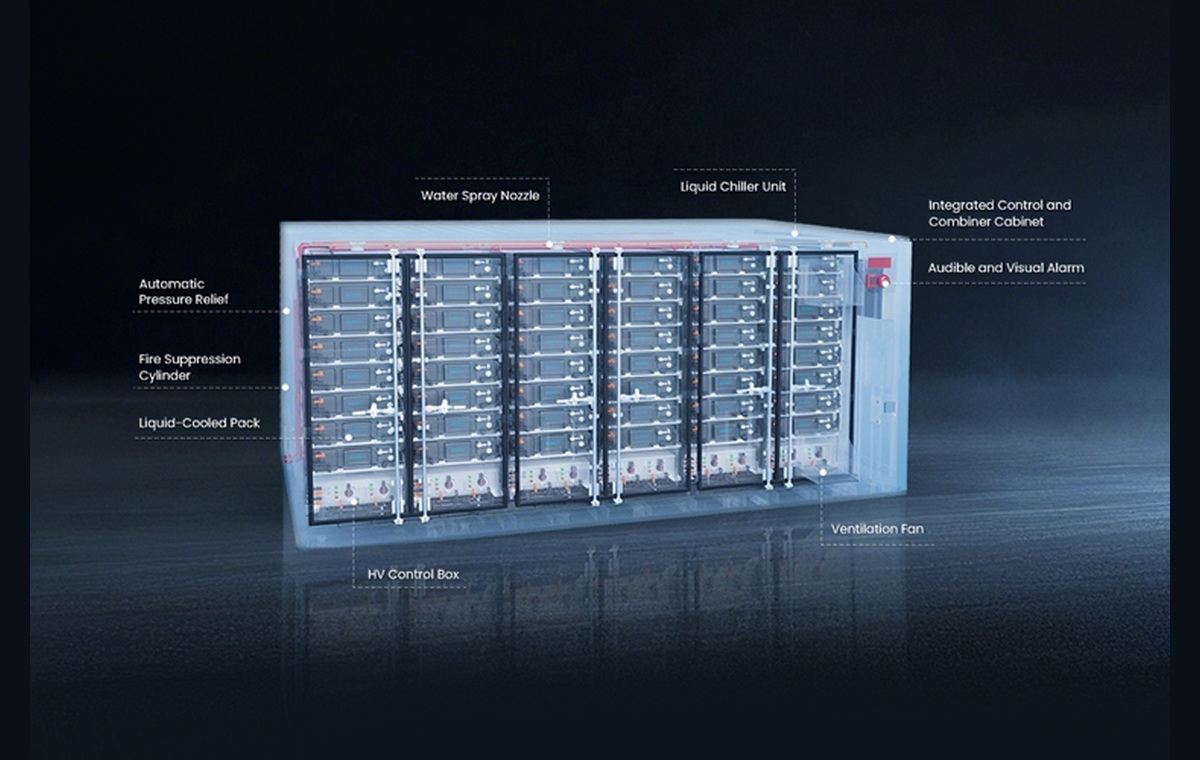
Large installations concentrate substantial stored energy in a relatively compact area, so safety planning must extend beyond individual cells. Structural design, electrical protection, fire detection and suppression, thermal management, control logic, access planning, and fault containment all contribute to risk management.
A utility-scale storage project also operates for years, which means safety cannot be treated only as a commissioning requirement. Inspection, diagnostics, maintenance procedures, and lifecycle risk controls need to remain effective as equipment ages and operating conditions change.
Seven layers of structural safety, five layers of fire protection, and lifecycle risk management are specified in Dunext’s utility solution. For utility scale energy storage, those details give developers a concrete way to examine whether protection is distributed across multiple failure paths instead of concentrated in a single feature.
The comparison can then extend to whether those protections remain maintainable throughout the operating life of the project.
Integration and Grid Compatibility Shape Real Operation
A storage plant is part of a larger electrical and control environment. It must exchange commands and data with energy-management or supervisory systems, coordinate with power-conversion equipment, and respond correctly to the grid conditions defined for the site.
Compatibility with different EMS environments can therefore become a practical project issue, especially where the owner, integrator, and equipment supplier use different control platforms. Utility-scale storage must also be engineered so that protection settings, communication paths, dispatch commands, and operating limits do not conflict with one another.
Dunext states that its utility solution supports energy trading, peak shaving, and frequency regulation, while design priorities include efficiency, reliability, long-life cells, durable cycling performance, and compatibility with different EMS environments. These points connect product design with the actual work expected from utility scale energy storage rather than treating control integration as a secondary feature.
For a developer, the important question is whether the complete plant can execute the intended grid service consistently, not whether each subsystem performs well in isolation.
Manufacturing and Service Affect Long-Term Project Risk
Project quality is influenced before installation begins. Repeatable manufacturing, component traceability, validation, and documented production control can reduce uncertainty about what has been built into each delivered unit. Dunext reports highly automated production lines with a 95% automation rate and 100% material traceability.
For utility-scale storage, traceability can be particularly relevant because a large project may contain many repeated modules or assemblies, making clear production records valuable for quality management and later fault investigation.
Long-term support is another part of the development calculation. Spare-parts availability, local warehouses, technical response, and service procedures affect how quickly a fault can be addressed after commercial operation begins. Dunext describes local warehouses, spare-parts depots, and an SLA-backed response model, and reports more than 100 utility projects in over 20 countries with more than 3 GW delivered.
These figures are evidence of project exposure and service infrastructure, although every new project still requires its own assessment of site conditions, contractual obligations, and local support arrangements.
Utility-scale battery development is therefore a sequence of linked decisions rather than a purchase centered on one container specification. The operating duty defines the required battery behavior; that behavior influences sizing, safety, control, and lifecycle expectations; those requirements then shape supplier, manufacturing, and service evaluation.
A strong utility scale energy storage project keeps those links visible from feasibility through operation. The most robust development process is the one that makes technical, grid, safety, and support assumptions explicit before construction fixes them in place.
