
Water with relatively low total dissolved solids (TDS) does not necessarily require the same reverse osmosis configuration as highly saline water. Lower-salinity sources generally have lower osmotic pressure, which can allow RO systems to operate at lower pressures when other operating conditions are suitable. Understanding feed-water quality, operating conditions, and the intended water use can help engineers choose a more suitable treatment approach.
What Does TDS Mean in Water Treatment?

Total dissolved solids refer to the combined concentration of dissolved substances in water, including salts and minerals. TDS is commonly used as an indicator of overall dissolved content, although it does not identify the individual substances present. Two water sources with similar TDS values can therefore still have different chemical characteristics and treatment requirements.
For RO system design, TDS is particularly relevant because dissolved salts affect osmotic pressure and influence the pressure needed to move water through the membrane. As feed-water salinity increases, the system generally needs to overcome greater osmotic pressure. This is one reason why membrane products are developed for different water-quality ranges rather than being treated as interchangeable.
Why Lower-TDS Water Can Suit Low-Pressure RO
A low tds ro membrane is intended for applications where the feed water contains less dissolved salt than seawater or highly concentrated brackish water. Lower-TDS feed water can require less operating pressure than more saline sources, creating an opportunity to use membrane systems designed for lower-pressure operation.
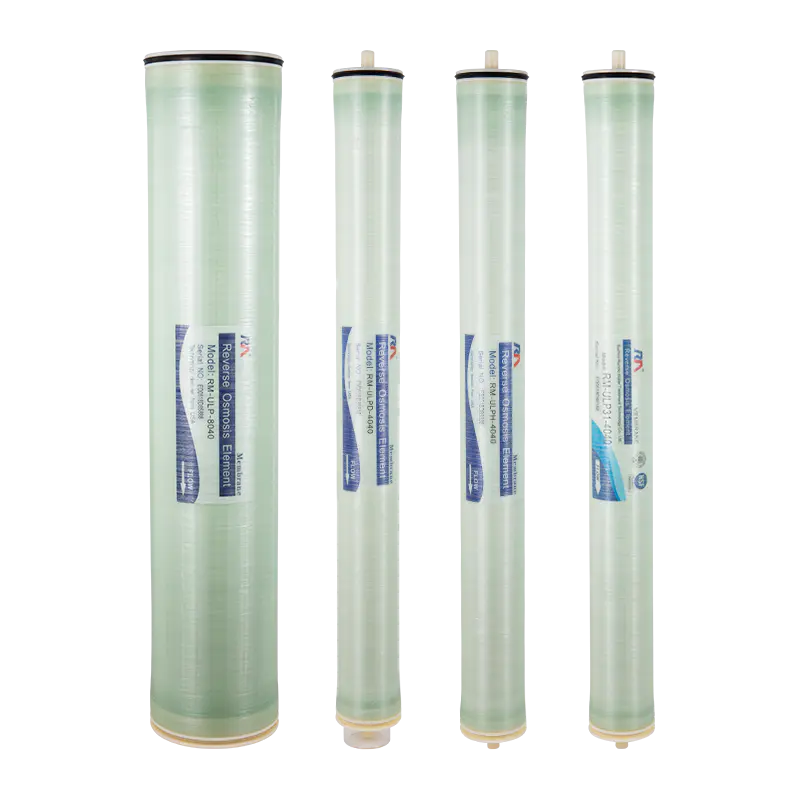
Runmo’s ULP/XULP series is made from thin-film composite polyamide membrane material and is designed to achieve the required permeate production and desalination performance under ultra-low or extremely low-pressure conditions. The manufacturer states that its operating pressure is about two-thirds that of conventional composite membranes, while the stable rejection rate varies by model, ranging from 97.5% to 99.5% under the stated testing conditions.
Lower-pressure operation can have practical implications for the wider system. The manufacturer notes that reduced pressure requirements may help lower the investment associated with pumps, pipelines, pressure vessels, and related equipment, while also reducing operating costs for the RO system.
Which Low-TDS Water Sources Can ULP RO Membranes Treat?
The feed-water range is one of the most important differences between membrane products.The ULP/XULP series is specified for the desalination treatment of surface water, groundwater, tap water, and municipal water with a maximum feed-water TDS of 2,000 ppm. The listed industrial applications include pure-water preparation, boiler recharge water, food processing, and pharmaceutical manufacturing.
This does not mean every low-TDS source is automatically suitable for the same RO membrane. Surface water and groundwater can contain different levels of turbidity, hardness, organic matter, and other substances even when their TDS values are relatively low. Pretreatment and feed-water analysis therefore remain essential parts of membrane selection.
A system designer should look at TDS together with other indicators rather than using one number as the sole selection criterion. Parameters such as temperature, SDI, turbidity, hardness, COD, BOD, TOC, residual chlorine, and pH can influence operating stability and membrane protection.
Product Options for Different Feed-Water Conditions
Runmo provides several models within its ULP/XULP range, allowing the membrane element to be matched more closely to system size and required production. The listed models include RM-XULP-4021, RM-XULP-4040, RM-ULP-2521, RM-ULP-2540, RM-ULP-4021, RM-ULPD-4040, RM-ULPH-4040, RM-ULP31-4040, and RM-ULP-8040. Depending on the model, membrane area ranges from 1.5 m² to 37 m², while the manufacturer’s listed average permeate production ranges from 1.13 m³/day to 39.5 m³/day under specified test conditions.
For example, the RM-XULP-4040 has a listed membrane area of 7.9 m² and average permeate production of 7.5 m³/day, while the larger RM-ULP-8040 provides 37 m² of membrane area and 39.5 m³/day average permeate production. These figures are based on the manufacturer’s testing conditions and should not be interpreted as guaranteed field output.
The ULP/XULP series also has a listed maximum feed-water TDS of 2,000 ppm, maximum feed-water temperature of 45°C, and continuous operating pH range of 2–12. The published specifications include additional limits for SDI, turbidity, hardness, COD, BOD, TOC, and residual chlorine. Checking these limits against actual site conditions is an important step before ordering.
Where Low-TDS RO Systems Are Useful
Low-pressure RO can be relevant wherever relatively low-salinity water needs further desalination or purification. Industrial facilities may use RO for pure-water preparation, while other applications can include boiler recharge water, food processing, and pharmaceutical manufacturing. These industrial fields are also identified for the ULP/XULP membrane series.
The economic advantage of low-pressure operation can also matter for smaller water-treatment systems. Lower pump requirements may simplify system design, while reduced operating pressure can contribute to lower energy use. The actual benefit, however, depends on the complete installation, including recovery, pretreatment, pump efficiency, membrane loading, and water-quality targets.
For engineering companies and solution providers, the main question is therefore not simply whether the feed water has a low TDS value. The more useful question is whether the membrane’s recommended operating range matches the complete water profile and whether its performance fits the required system output.
What to Check Before Choosing a Membrane
Before selecting a membrane, obtain a current feed-water analysis and define the desired permeate quality. TDS provides a useful starting point, but it should be reviewed alongside temperature, pH, turbidity, SDI, hardness, organic content, and other relevant conditions.
Pretreatment should also be planned before the RO stage. The published ULP/XULP specifications include feed-water limits for maximum SDI, turbidity, hardness, and residual chlorine. Maintaining suitable inlet conditions helps protect the membrane and supports more stable operation.
Commercial factors matter as well. Water-treatment businesses often have to balance membrane quality, purchase price, delivery time, customization requirements, and ongoing technical support. Evaluating these considerations alongside technical compatibility provides a clearer basis for comparing suppliers.
Matching the Membrane to the Water
A lower-TDS feed source can create an opportunity for ultra-low-pressure RO, but the decision still needs to be based on the complete water profile rather than TDS alone. Surface water, groundwater, tap water, and municipal water can each present different treatment challenges even when their dissolved-solids levels fall within a similar range.
Runmo offers ULP/XULP membrane options for lower-salinity water sources, alongside other RO, UF, NF, seawater, and brackish-water products. Its manufacturing and product range give buyers different membrane configurations to consider according to application, capacity, and feed-water conditions. For a project involving lower-salinity water, the actual water analysis should be compared with the membrane’s published operating limits before selection, while the ULP/XULP series can be evaluated against the project’s feed-water and performance requirements
