
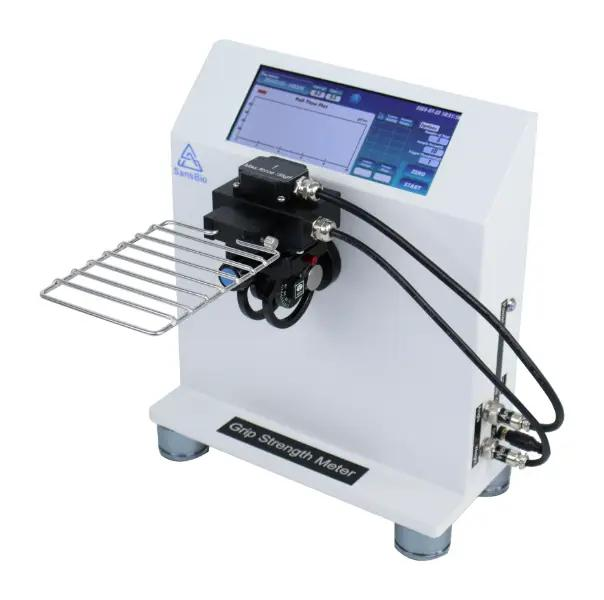
Grip strength testing is often used when researchers need a functional measure of muscular or neuromuscular performance in rodents. The key choice is not simply which device to purchase, but which body region should provide the primary endpoint.
Forelimb-only and four-limb protocols address somewhat different research questions, so the testing configuration should follow the study objective, animal model, and planned analysis.
Define the Functional Question

Start by identifying what the experiment is intended to capture. A forelimb grip strength test focuses on performance generated through the forelimbs and is particularly relevant when the research concerns neurotoxicity, peripheral nerve injury, or drug-induced changes in forelimb motor performance.
A four-limb test provides a broader measure of overall muscle strength. The official product FAQ associates this approach with aging studies, sarcopenia research, and systemic neuromuscular disease models. These distinctions can help researchers select an endpoint that matches the biological scope of the study.
Consider What Changes the Endpoint
The selected endpoint should reflect the type of effect under investigation. When a treatment or disease model is expected to influence forelimb motor performance specifically, a forelimb measurement may offer a more targeted outcome.
When the research question concerns broader changes in muscle strength, a four-limb protocol may provide a wider functional readout.
The experimental plan should also specify how peak force will be handled. During testing, the rodent grasps a grid or bar connected to a force transducer, and the animal is gradually pulled until the grip is released. The measured maximal tensile force is recorded as peak force.
Match the Grip Surface to the Protocol
The physical attachment matters because the animal’s grip and testing geometry affect how the measurement is obtained. The Grip Strength Meter Pro includes seven interchangeable grip attachments: two mesh grids and five triangular bars. These options are designed for different rodent grip-testing requirements.
The system is suitable for both rats and mice. Its specified force range is 0–5000 g (50 N) for rats and 0–1000 g (10 N) for mice, while force resolution is 0.1 gf. The testing angle can be adjusted through a 90° range, with 0.1° sensor resolution specified.
Keep Species and Setup Consistent
Mouse and rat measurements should be treated as species-specific datasets. The same instrument accommodates both species, but the manufacturer provides different force ranges and grip-surface dimensions for rats and mice.
For mice, the listed mesh grid measures 9 × 12 cm, with a 0.20 cm bar diameter. The triangular bars available for mice have dimensions of 6 × 7 cm, with diameters of 0.20 cm and 0.15 cm. Keeping species, attachment type, testing angle, and other protocol variables clearly documented can make comparisons across sessions easier to interpret.
Plan Repeated Trials Carefully
Repeated trials can be useful when a study requires several measurements or wants to examine variation across attempts. However, the number of trials, interval between attempts, and rule for selecting the reported value should be established in advance.
The Grip Strength Meter Pro supports up to 20 trials in a session. Its touchscreen can display real-time grip force curves, peak tension, duration, and average values. Each trial’s curve, peak force, and duration are automatically recorded, while animal information can include ID, age, weight, sex, grouping, and remarks.
Build the Data Record Around the Endpoint
A useful dataset should preserve the context behind each force measurement. Record whether the study uses forelimb or four-limb testing, the animal species, attachment type, testing angle, and trial information alongside the force result.
The Pro model stores up to 2,000 records, supports history viewing, and allows CSV export through USB flash storage. It also samples at 1000 Hz and provides threshold-based auto-recording. These functions can support later review when researchers need to examine individual trials rather than relying on a single summary value.
Choose Equipment That Fits the Study
The appropriate endpoint depends on the biological question. Forelimb and four-limb protocols provide different types of functional information: one focuses on forelimb motor performance, while the other offers a broader measure of overall muscle strength. Comparing the expected disease or treatment effect with the intended endpoint can help researchers finalize the protocol.
BioMed Easy Technologies, a subsidiary of SANS Biotechnology, develops equipment for animal behavior and neuroscience research. BioMed Easy Technologies began with 2,200 m² of R&D and manufacturing space in 2017, one year after its founding in 2016, and its manufacturing center has since expanded to more than 7,000 m² in 2024.
For laboratories planning rodent strength studies, review the official specifications and discuss the intended forelimb or four-limb endpoint with BioMed Easy before setting up the workflow. This can help align the selected configuration with the study model, testing procedure, and data requirements.
