
Selecting machinery for a chemical processing plant involves more than comparing motor power and production capacity. Noise affects the working environment, vibration can influence equipment reliability and surrounding installations, and the machine’s footprint determines how efficiently available floor space can be used. For procurement managers and plant engineers, evaluating these factors early helps prevent costly installation changes. Asking targeted questions also helps identify industrial mixing solutions that fit the process, facility, and long-term operating requirements.
What Noise Level Should Operators Expect?

Noise can originate from motors, rotating components, material flow, pumps, and interactions between machinery and connected piping. Actual sound levels depend on equipment design, operating speed, material properties, installation conditions, and the surrounding environment.
When evaluating chemical mixing equipment, buyers should ask manufacturers for measured noise data under defined operating conditions. Important questions include:
What is the typical sound pressure level, measured in dB(A)?
At what operating speed, load, and distance was it measured?
Does the measurement represent the mixer alone or the complete installation?
Are noise-control measures available if the equipment exceeds workplace targets?
A noise figure is useful only when its measurement conditions are clear. Buyers should also assess local occupational noise requirements and determine whether additional acoustic enclosures, barriers, or hearing protection may be necessary. These measures should be considered alongside maintenance access and heat dissipation.
How Is Vibration Controlled?
Vibration deserves particular attention in high-speed mixing and dispersion processes. Poor alignment, unbalanced rotating components, unsuitable mounting, and inadequate pipe support can contribute to unwanted movement. Excessive vibration may increase wear, loosen connections, disrupt nearby instruments, or create maintenance problems.
Buyers should ask whether the manufacturer provides vibration measurements, installation tolerances, alignment instructions, and recommendations for foundation design. It is also important to clarify whether vibration isolators are required and whether connected pipes need independent support.
The installation environment matters as much as the machine itself. A rigid, level foundation can help support stable operation, while improperly selected vibration isolators may worsen movement rather than reduce it. The appropriate arrangement should therefore be assessed against the machine’s operating characteristics and site conditions.
What Does the Total Installation Footprint Include?
A machine’s dimensions rarely tell the whole story. The actual installation footprint may include the main unit, motor, pump, feeding hopper, piping, electrical cabinet, service access, and space for cleaning or component replacement.
Before approving a layout, procurement and engineering teams should request a dimensioned general arrangement drawing. They should confirm the machine’s height, inlet and outlet positions, connection sizes, maintenance clearances, lifting requirements, and any foundation specifications.
For in-line systems, the layout of upstream and downstream chemical mixing equipment is particularly important. A compact mixing unit may still require considerable surrounding space for powder feeding, recirculation, or material transfer. Evaluating the complete process arrangement helps buyers compare industrial mixing solutions on usable production space rather than equipment dimensions alone.
Does the Mixing Process Match the Equipment Design?
Noise, vibration, and footprint should be evaluated alongside process performance. Buyers need to establish whether the equipment can handle the actual powder characteristics, liquid viscosity, required throughput, and sensitivity of the formulation.
For difficult-to-dissolve powders, incomplete wetting can produce agglomerates commonly known as fish eyes. Additional mixing time may not resolve the problem efficiently and can expose shear-sensitive materials to unnecessary processing.
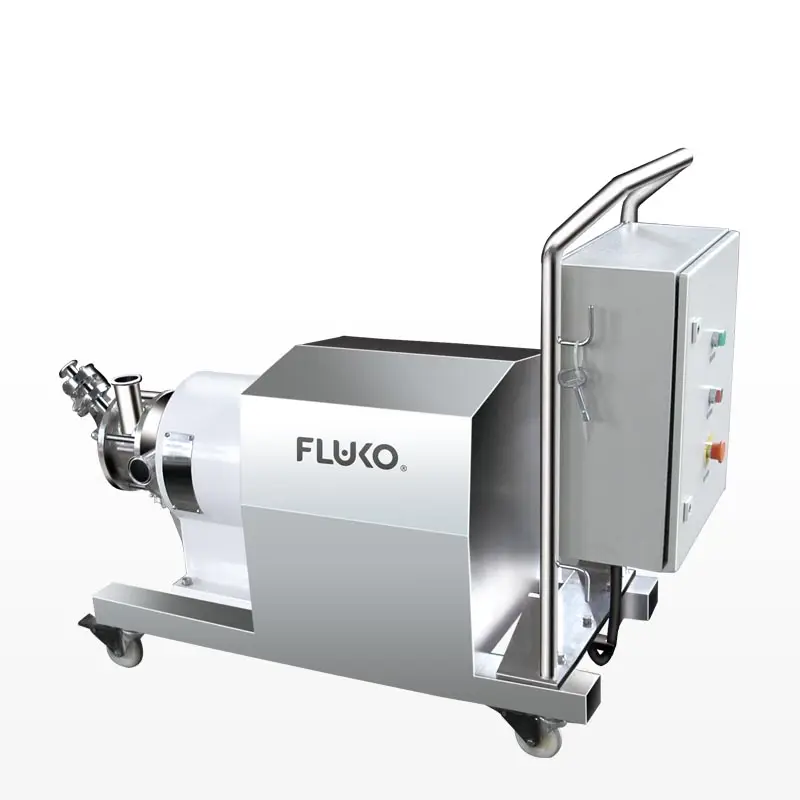
The PD-X Series from FLUKO is a production-type in-line solid-liquid dispersion mixer designed for difficult-to-dissolve powders. Its structure pre-wets powder before it enters the mixing chamber, helping prevent fish-eye formation. Vacuum operation minimizes air ingress, while powder suction through a hose or hopper supports rapid feeding, wetting, and dispersion. The system also supports recirculation.
These process characteristics may help reduce mixing time and improve material utilization, depending on the formulation and operating conditions. However, they do not establish a specific noise level, vibration rating, or installation dimension. Buyers should request those details directly when assessing the PD-X Series for a particular facility.
What Evidence Should the Manufacturer Provide?
A reliable technical evaluation requires documentation that can be checked against actual operating needs. Beyond a product brochure, buyers should request a complete specification sheet, installation drawing, operating manual, and relevant test data.
For chemical mixing equipment, useful supporting information includes rated motor power, operating speed, applicable viscosity range, flow capacity, connection requirements, and recommended maintenance clearances. Where noise and vibration are critical, buyers should request test results or written guidance specific to the proposed configuration.
FLUKO’s PD-X Series product page lists six models, from PD10-X to PD230-X, with different power ranges, powder-feeding capacities, and flow rates. Selecting the appropriate model requires matching these parameters to the intended process. Noise, vibration, and space requirements should then be confirmed for the selected configuration rather than assumed from the series name.
Make Equipment Selection a Whole-Facility Decision
Choosing industrial mixing solutions is ultimately a decision about how machinery will perform within an entire production environment. Noise data, vibration-control recommendations, installation drawings, and process specifications provide a stronger basis for comparison than headline performance figures alone.
By addressing these questions before purchase, plant engineers and procurement teams can reduce installation risks, plan maintenance access, and select equipment suited to both production demands and facility constraints. FLUKO‘s solid-liquid dispersion technology offers an option for powder-intensive chemical processes, while a thorough technical review helps buyers determine whether the proposed configuration meets their specific operational requirements.
