
Consumers standing in a checkout queue frequently occupy a unique psychological state. Experiencing decision fatigue from their prior shopping tasks and having a few idle moments to pass, shoppers generally display a lowered resistance to small, affordable indulgences. This environmental dynamic explains why the confectionery category generates a disproportionate share of its overall revenue directly from impulse merchandising zones.
Novelty gummies offer a distinct structural advantage in this specific retail environment because they perform a function that standard candy shapes struggle to achieve. They create an immediate moment of visual surprise that interrupts the routine, autopilot scanning behavior of the waiting shopper. A product that looks remarkably like a savory meal, yet is clearly a sweet treat, triggers a brief cognitive pause. This pause frequently precedes an unplanned purchase decision. For retail operators and any strategic wholesale candy supplier, understanding the mechanics of this impulse conversion is not merely an exercise in merchandising trivia. Rather, it serves as a direct driver of increased basket margins and accelerated category sales velocity.
The Cognitive State of Consumers in Impulse Zones
Research regarding point-of-sale consumer behavior indicates that individuals waiting in checkout queues experience heightened susceptibility to low-cost, low-risk purchases. Retail strategists often refer to the “waiting tax” phenomenon, which suggests that shoppers who might otherwise bypass a dedicated grocery candy aisle will frequently pick up a small item if it is placed directly in their idle line of sight. These transaction decisions are typically made in under three seconds. They are governed primarily by immediate visual appeal and acceptable price thresholds, rather than any pre-planned shopping intent.

Novelty gummies manage to exploit this brief conversion window highly effectively because they introduce an element of unexpected discovery. The consumer is not merely evaluating a standard fruit snack; they are reacting to a visually unexpected object. Wondering about the texture and taste of a miniature, sweet burger creates a quick spark of emotional engagement. This minor psychological engagement frequently helps convert a state of passive waiting into an active purchasing action.
Why Shape Novelty Outperforms Familiar Forms at Checkout
Standard gummy shapes, such as traditional bears, worms, and rings, largely function as visual background noise within the mature confectionery aisle. Consumers tend to process these familiar forms automatically without registering active curiosity. In an impulse merchandising zone, where a product has roughly 1.5 seconds to capture active attention, familiar shapes often fail to trigger the orienting response that neurological studies associate with novel and unusual stimuli.
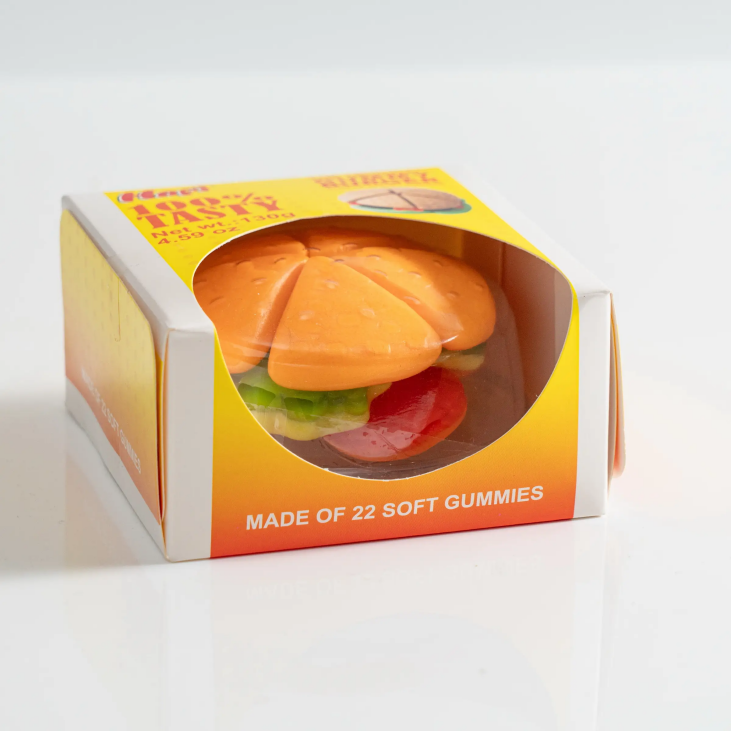
Food-shaped novelties, particularly items like hamburger candy, resolve this visual fatigue through a built-in aesthetic paradox. The multi-layer construction—featuring a tan bun, a brown patty, green lettuce, and red tomato details—creates a complex color field that draws the eye, even when viewed in peripheral vision. HAPI produces this detailed hamburger candy in various formats, ranging from compact 10g single-serve packs to substantial 90g giant burgers. This format flexibility allows retail operators to match the specific product scale directly to their available checkout fixtures and targeted price-point strategies.
Placement and Merchandising Tactics for Maximum Conversion
Driving impulse performance relies heavily on strategic location in addition to product selection. Presenting merchandise at eye-level or within comfortable arm’s reach generally increases physical pick-up rates by a notable margin compared to below-waist positioning. Utilizing end-cap displays situated near high-traffic beverage coolers successfully captures cross-category shopping trips. Furthermore, implementing seasonal power wings and dedicated dump bins helps create a sense of visual abundance and purchasing urgency. The most effective retail operators routinely rotate their novelty SKUs every four to six weeks to maintain a continuous sense of discovery for repeat shoppers.
Merchandising adjacency also heavily influences checkout conversion rates. Placing novelty gummies near functional register items, such as batteries, chewing gum, or mints, effectively leverages the shopper’s existing impulse mindset. Alternatively, pairing highly visual novelty pieces alongside conventional candy options can create a beneficial trade-up dynamic. In this scenario, the striking novelty item drives the initial customer engagement with the display, and the conventional item frequently completes the transaction as a secondary basket addition.
Packaging and Portion Control as Conversion Levers
Impulse conversion depends on perceived purchase risk. Single-serve packs (10–30g) minimize both financial cost and dietary commitment, removing the psychological barrier. For novelty products, transparent or windowed packaging is essential—the shape itself is the selling proposition, and hiding it behind opaque wrapping destroys the visual trigger that drives the purchase. Retailers should evaluate suitable price points based on product size, wholesale cost, target customers, and the pricing conditions of the intended market.
Seasonal and limited-edition packaging amplifies impulse behavior through scarcity signaling. A Halloween-themed release or a Valentine’s heart-shaped hamburger candy creates a time-sensitive decision frame that bypasses rational evaluation. Retailers who align these product drops with their holiday merchandising calendars see measurable spikes in both unit velocity and basket size.
The Economics of a Sustainable Novelty Impulse Program
The novelty candy segment operates as a relatively high-churn category; a specific visual concept that performs exceptionally well in the first quarter may experience slowing sales by the third quarter. Sustaining a profitable program requires collaborating with manufacturing partners capable of delivering new product concepts without imposing prohibitive custom tooling costs or highly extended lead times. The ideal production partner maintains a core catalog of proven shapes while offering rapid custom development for exclusive private-label concepts. Strict inventory discipline remains critical, as over-ordering on untested novelty SKUs risks tying up working capital and forcing future margin markdowns.
Experienced retail buyers frequently treat the novelty segment as a rotating portfolio rather than relying on a single permanent SKU. Maintaining three to five active novelty shapes with staggered launch dates helps protect against consumer fatigue while establishing a store reputation for assortment freshness. The primary objective is to secure a wholesale candy supplier who effectively combines creative agility with strict production consistency. This ensures that every subsequent inventory reorder accurately matches the visual and structural quality of the initial pilot batch.
Evaluating Impulse Performance and Refining Assortments
Measuring impulse success requires more than unit sales volume. Basket analysis reveals whether novelty gummies drive standalone purchases or lift broader category baskets. Placement-based sell-through testing compares checkout versus end-cap performance, while social media monitoring captures organic consumer content that signals viral potential.
HAPI aligns its production with impulse-category economics. As a wholesale candy supplier with 25 years of experience, it offers OEM and private-label services from 500 cartons MOQ, with 7–10 day lead times for catalog products and 15–25 days for custom work. Its automated line handles 30 metric tons daily, keeping fast-moving impulse SKUs in stock. FSSC 22000 and ISO 22000 certifications, plus a 2025 SEDEX audit, give retailers the food-safety documentation and supply reliability needed to run impulse programs at scale.
