
A prototype that fits on the bench does not automatically define what the next fifty parts must look like. The first unit may have benefited from manual adjustment, a temporary material choice, or extra inspection that will not accompany every repeat order.
Before approaching a precision parts manufacturer, the purchasing and engineering teams need to establish which prototype decisions are now fixed and which remain open. The goal is not merely to reproduce an object, but to transfer an agreed specification into a repeatable order.

Release a Requirement That Production Can Follow
The approved prototype and the released production file are different kinds of evidence. A physical sample demonstrates one result; a controlled drawing states what future parts must meet.
Revision number, material grade, finished dimensions, applicable tolerances, and acceptance criteria belong in the release package. If an enclosure must align with a mating assembly, its interface dimensions deserve explicit control even when the remaining surfaces can accept ordinary manufacturing variation.
Functional requirements also determine how much documentation is needed. A cosmetic cover may call for a finish sample and agreed appearance criteria; a precision bracket may require inspection at defined datums.
Assembly tests, material certificates, or first-article measurements can become part of acceptance where the contract demands them. Leaving these requirements for the purchase order’s final days usually creates avoidable clarification cycles between engineering, production, and procurement.
Use Geometry and Volume to Narrow the Process Route
Process choice follows geometry and expected quantity rather than the label attached to the project. Three- or four-axis CNC milling handles accessible pockets and drilled patterns, turning suits cylindrical parts, and five-axis machining addresses more complex multi-face designs.
Laser cutting and bending are suitable for many sheet components; additive manufacturing can form an early fit-check part without dedicated mold tooling. A precision parts manufacturer should be assessed against the actual drawing and anticipated batch size, not the length of its equipment list.
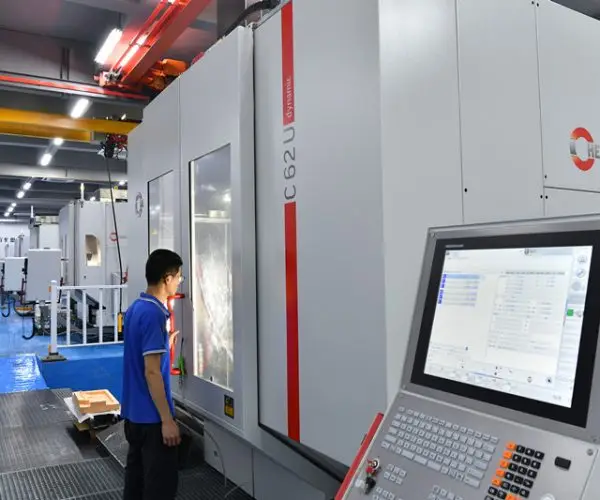
An evolving geometry might be CNC-machined or 3D-printed first, while a stable tooling-dependent design may proceed to die casting or injection molding; Hanstar Technologies can also address five-axis work and sheet metal fabrication. Its equipment inventory includes nine five-axis centers, forty-nine three- or four-axis centers, twenty CNC lathes, eight die-casting machines, and eighteen injection-molding machines.
That range permits several process routes to be discussed for metal or polymer components. Nevertheless, tooling costs, surface requirements, functional loads, and the stability of the design determine which route makes sense for a particular order.
Expose the Changes Hidden Between One and Fifty
A one-piece machining job may allow a fixture adjustment that becomes costly to repeat over several batches. Conversely, a molded part needs a prepared tool even if only a modest number of pieces are ordered.
Production planning therefore includes setup work, expected scrap or rework, secondary finishing, inspection time, and packaging—not only the per-part cutting or molding cycle. Cost comparisons are meaningful only when each quotation covers the same part condition and documentation scope.
There is no strict minimum quantity for Hanstar’s CNC prototype work and other eligible low-volume requests, while molded or larger-volume orders depend on process and tooling conditions. A sensible first release can preserve the option to change the design after testing, with a defined checkpoint before repeat production. At that checkpoint, a purchaser needs to know whether the toolpath, material source, or finishing method will remain the same for the next shipment.
Keep Quality Records Attached to the Correct Revision
Manufacturing evidence loses value if it cannot be matched to the supplied part. Material identification, inspection results, and certificates need a clear association with the drawing revision and the lot concerned.
Critical features can be measured with coordinate-measuring equipment, while simpler characteristics may use dedicated gauges. The extent of inspection should reflect the contractual specification; a complete quality file is not necessarily a requirement for every noncritical prototype.
Hanstar Technologies uses Zeiss coordinate-measuring machines and other inspection instruments for finished machined components, with material and dimensional records available where required. Its quality management certifications include ISO 9001, IATF 16949, AS9100D, and ISO 13485.
These systems describe organizational quality controls rather than granting a blanket product approval. For a recurring order, the useful question is which records can be supplied consistently and how changes will be communicated before the next batch is made.
Write the Repeat Order Before It Is Needed
A purchasing checklist becomes more valuable when it extends past first-article acceptance. It can capture likely batch frequency, quantity ranges, packaging, visible surfaces, agreed finish, and the point at which a drawing revision requires renewed approval.
A precision parts manufacturer may also need updated demand information if the project shifts from machined prototypes to a tooling-dependent process. Earlier assumptions about lead time and unit economics must then be checked again.
Between prototype approval and the next purchase order, the same material, revision, critical dimensions, and inspection expectations must remain identifiable. Hanstar Technologies can assess a released model, initial quantity, anticipated repeat volume, and required records to discuss a practical route for the next batch. A purchasing request that includes those details begins with fewer unresolved decisions than a prototype photo and a target delivery date alone.
