
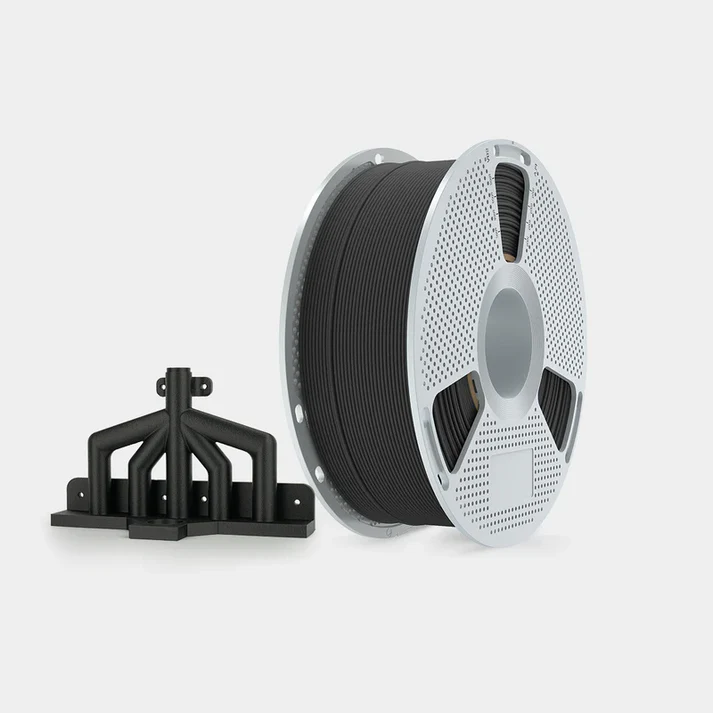
Polymer innovation in desktop 3D printing continuously expands possibilities for functional engineering. While traditional standard Nylon remains a trusted choice for flexible components, reinforcing polyamide resins with micro-carbon strands yields specialized blends built for high-stress applications.
Deciding whether composite spools fit your production needs requires evaluating mechanical rigidity, thermal thresholds, and printing requirements. Comparing these factors helps makers determine if stepping up from baseline polymers makes practical and financial sense.

Defining Standard Unfilled Nylon
Standard Nylon, or unreinforced Polyamide, is widely appreciated in additive manufacturing for its impressive impact resistance and low surface friction. It excels at producing components that absorb repeated physical shocks without shattering abruptly under tension.
However, baseline Polyamide experiences significant volumetric contraction as extruded plastic cools. Large prints frequently pull away from build plates, causing severe corner warping unless processed inside heated chambers using specialized bed adhesives and brim structures.
In addition, unfilled formulations lack extreme structural rigidity. Components may deform more under mechanical loads than carbon-fiber-reinforced Nylon, depending on the formulation and print orientation.
What Sets PA6-CF Apart?
Compounding chopped carbon fiber micro-strands into a Polyamide 6 matrix resin creates PA6-CF. These embedded fibers establish an interconnected internal reinforcement network throughout the polymer structure, dramatically boosting overall rigidity and dimensional stability.
This structural fiber network effectively stabilizes molten material during layer deposition. Thermal contraction drops significantly during cooling, allowing intricate geometries and flat-bottom enclosures to print cleanly without severe bed lifting or internal warping stress.
High-grade spools produced by SUNLU feature carefully sieved fiber lengths and consistent strand diameters. These engineered specialty filaments can support the production of functional parts on suitably equipped desktop 3D printers.
Structural Rigidity vs Impact Flexibility
Examining mechanical behavior reveals contrasting performance profiles between these two materials. Unfilled Polyamide provides outstanding ductility, stretching under extreme stress before failing, which makes it ideal for snap-fit latches, living hinges, and protective bumpers.
On the other hand, PA6-CF delivers exceptionally high flexural modulus and tensile strength under continuous load. PA6-CF provides higher stiffness than unfilled Nylon, which can help reduce deformation under mechanical loads.
Consequently, composite formulations are superior for functional mounting brackets, motor mounts, robotic arms, and structural frames. Where baseline Nylon sacrifices stiffness for impact flexibility, carbon reinforcement provides higher structural rigidity for applications subjected to substantial mechanical loads.
Thermal Resistance under Heavy Loads
Temperature tolerance marks another critical divide between baseline and composite polymers. Standard Polyamide softens rapidly when exposed to elevated heat, restricting its practical deployment near running motors, heated electronic enclosures, or automotive engine bays.
Incorporating micro-carbon strands increases heat deflection temperatures substantially under mechanical load. Components printed with PA6-CF has a published heat deflection temperature of 203±3°C, while the product page highlights heat resistance up to 209°C; these values should not be treated as guaranteed continuous-use temperatures.
Utilizing premium SUNLU composite spools allows engineers to manufacture custom intake manifolds, heat-shield brackets, and industrial ducting. These functional parts reliably withstand high-temperature conditions that would quickly ruin standard desktop filaments.
Visual Quality and Layer Boundary Disguise
Aesthetic surface characteristics differ dramatically between raw and filled Polyamide options. Unfilled Nylon extrudes with a slightly glossy, semi-translucent finish that often highlights tiny layer boundaries and minor surface imperfections across vertical walls.
Conversely, extruding PA6-CF produces a stunning matte dark grey surface finish. Microscopic carbon strands disperse light reflections evenly across the print, effectively concealing layer lines and providing a professional, factory-molded visual appearance.
The matte surface can reduce the visual prominence of layer lines, although additional post-processing may still be required for specific appearance requirements. Functional prototypes and end-use components look ready for client presentation straight off the build plate without requiring extensive sanding, priming, or surface painting.
Hardware Upgrades and Nozzle Requirements
Transitioning to fiber-reinforced thermoplastics requires specific machine modifications before printing. Chopped carbon strands act like microscopic abrasives during extrusion, wearing down standard desktop hotend components as molten filament passes through the nozzle tip.
Running PA6-CF through a soft brass nozzle will quickly erode the internal orifice, ruining print precision and extrusion control. Operators must install hardened steel, tungsten carbide, or ruby-tipped nozzles to handle continuous fiber abrasion.
SUNLU recommends a nozzle temperature of 270–290°C for PA6-CF, with the exact setting adjusted according to the printer and print conditions. SUNLU specifies PA6-CF for high-temperature printing, while consistent results still depend on nozzle condition, temperature settings, drying, and printer setup.
Moisture Management and Drying Protocols
Both baseline Polyamide and composite materials are highly hygroscopic, drawing moisture directly from room air. Wet filament generates internal steam bubbles, severe stringing, noisy popping during extrusion, and significantly weakened inter-layer bonding strength.
Because PA6-CF is moisture-sensitive, the filament should be dried before printing and stored in a sealed, low-humidity environment with desiccant. Spools should undergo thorough drying inside dedicated filament ovens prior to printing and remain inside sealed dry boxes during long extrusion cycles.
Proper drying preserves material integrity and ensures smooth surface finishes on every build. Proper drying and storage can reduce moisture-related printing defects and help maintain the material’s intended mechanical performance.
Is the Upgrade Worth the Investment?
Although composite spools require higher initial costs and hardened machine components, the performance gains are undeniable. Exceptional stiffness, elevated thermal endurance, and precise dimensional control easily justify the upgrade for demanding functional projects.
If your CAD designs call for rigid load-bearing strength, elevated heat tolerance, and sleek matte aesthetics, PA6-CF is clearly worth the extra investment for serious engineering applications.
With a suitably equipped printer and proper drying and nozzle preparation, PA6-CF can support the production of functional components for demanding applications.
