
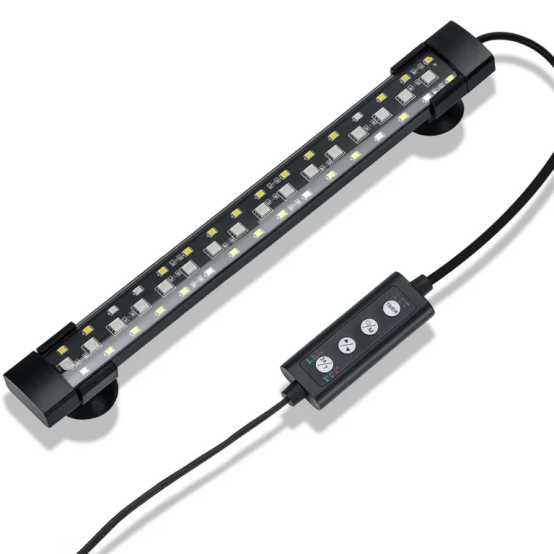
A planted aquarium in 2026 needs more than a bright lamp hanging above the water. A suitable Aquarium LED Light should provide useful spectral coverage, adjustable intensity, stable daily timing, and reasonable energy consumption according to the plants being grown. For example, HiTauing offers fixtures with full-spectrum output and programmable controls, but the more important question is how those features translate into healthier growth and better visual balance. Light selection becomes much easier once brightness, color, tank depth, and operating hours are considered together.

Understanding What Plants Actually Need
Aquatic plants respond to light intensity and spectral composition rather than brightness alone. Fast-growing stems, carpeting plants, and demanding red species generally require more carefully managed illumination than low-light varieties such as Anubias or Java fern. A fixture that is excessively intense can also encourage algae when carbon availability, nutrients, or water circulation do not match the lighting level.
Spectral balance is equally relevant to appearance. White light creates a natural viewing environment, while red and blue wavelengths contribute to the visual rendering of green and red foliage. Rather than selecting the strongest fixture available, aquarists should consider whether the light can be adjusted as plant density and tank conditions change.
Evaluating Spectrum And Color Temperature
Full-spectrum lighting has become increasingly common because it provides a broader visual range while making fish, plants, substrate, and hardscape appear more natural. In a planted aquarium, the useful range should be considered alongside intensity; spectral quality does not compensate for insufficient or excessive output.
Color temperature also affects the character of the display. Cooler settings can make water appear crisp and emphasize blue-green tones, while warmer settings may give wood, red plants, and darker substrates a softer appearance. Adjustable fixtures provide greater freedom to fine-tune the tank instead of relying on one fixed visual profile.
Matching Brightness To Tank Depth
Tank dimensions change how lighting should be evaluated. A shallow aquarium generally needs less intensity than a deep aquascape because light travels through a shorter water column before reaching the plants. A long tank creates another challenge: even illumination across the entire length may matter more than maximum output at the center.
The 24/7 WRGB Full Spectrum Fish Tank Lighting Freshwater Planted LED is an example of a fixture designed around this type of flexibility. It provides three color-light modes, a DIY setting that allows timer, color, and brightness adjustments, plus extendable brackets for different tank widths. Such controls can be useful when plant requirements vary between the foreground and background.
Balancing Growth With Energy Consumption
Running a planted aquarium light at maximum intensity for long periods is rarely the only way to support healthy growth. Photoperiod length, nutrient availability, and CO₂ levels interact with illumination, so changing one factor may require adjustments elsewhere in the system.
Programmable controls can make daily operation more consistent. Instead of manually switching the lamp on and off, a scheduled cycle can provide a defined lighting window and reduce accidental overexposure. An efficient Aquarium LED Light therefore offers value not simply through its LED technology, but through the degree of control available to the aquarist.
Considering Adjustability And Long-Term Use
Plant growth changes the lighting requirements of a tank. Newly planted aquariums may contain relatively sparse vegetation, whereas a mature aquascape can develop dense foliage that alters how light reaches lower leaves. Adjustable intensity gives the owner room to respond without immediately replacing the fixture.
Mounting flexibility deserves similar attention. Extendable brackets are useful when aquarium dimensions change or when the fixture needs repositioning during an aquascape redesign. In addition, heat management should not be ignored because prolonged operation inside a poorly ventilated environment can affect fixture performance over time.
A Practical Approach To Selecting A 2026 Fixture
While the About HiTauing page provides a useful starting point for understanding available lighting configurations, it should not be treated as a substitute for technical evaluation. The selection process should begin with plant species, followed by tank dimensions, depth, desired appearance, photoperiod, mounting position, and control options. Price and energy consumption can then be weighed against the expected operating period.
A useful aquarium LED light should fit the aquarium’s actual requirements rather than simply offering the largest number of features. For a low-light community tank, straightforward dimming may matter most; a demanding planted aquascape may benefit from broader spectral control and programmable operation. Maintenance should also remain part of the calculation, including cleaning, heat dissipation, bracket stability, and access to replacement components.
Conclusion
The most suitable planted-tank lighting in 2026 is not necessarily the fixture with the highest brightness or the longest feature list. Better results come from matching spectral characteristics, intensity, color adjustment, photoperiod, physical coverage, and energy use to the plants and aquarium dimensions. A flexible fixture can also make gradual changes easier as an aquascape matures.
A well-selected Aquarium LED Light should therefore be viewed as part of the aquarium’s wider growing system rather than an isolated accessory. Once lighting is coordinated with nutrients, CO₂, water movement, and plant selection, its role becomes much easier to manage. If you need more technical details or help choosing the right setup, reach out through the Contact Us page.
About HiTauing
With over 20 years of expertise in aquarium equipment, we deliver reliable, innovative solutions trusted by clients in 50+ countries. Our ISO9001 certified products, global certifications, and end-to-end support make us your ideal partner for aquatic success.
