
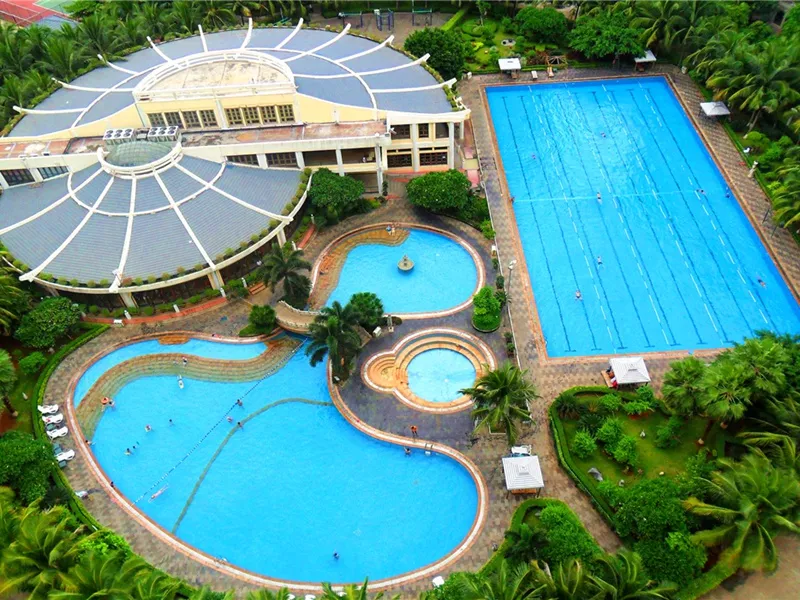
Commercial aquatic facilities cannot treat filtration as a secondary equipment choice. Filter performance affects water clarity, maintenance workload, hydraulic design, and water use. For operators planning a new attraction or upgrading an existing one, the right water-management strategy should balance filtration performance with operating conditions, maintenance resources, and long-term costs.
Why Filtration Matters to Commercial Pool Operations

Filtration removes suspended particles from recirculated water, while disinfection addresses microorganisms and other health risks. The CDC’s Model Aquatic Health Code treats filtration and recirculation as important parts of aquatic-facility design and operation, while recognizing that filtration cannot remove every dissolved contaminant. Operators therefore need an integrated treatment approach rather than relying on filtration alone.
For a commercial project, turnover requirements, hydraulic capacity, bather load, plant-room space, maintenance access, and local regulations all influence filter selection. The CDC’s MAHC provides science-based guidance for public aquatic facilities, while local authorities determine which requirements apply to individual projects.
DE Filters: High-Fineness Filtration With More Maintenance
Diatomaceous earth, or DE, is used as a precoat medium in suitable filters. Its fine particulate structure can provide strong removal of small suspended particles, making it attractive where water clarity is a high operational priority. The 2023 MAHC specifies that DE should be added to precoat filters according to the filter manufacturer’s recommendations.
The trade-off is operational complexity. DE systems require management of filter media and cleaning procedures, and discharged media must be handled according to applicable requirements. High-traffic facilities should evaluate filtration performance alongside staff workload, media handling, and plant-room procedures.
Sand Filters: A Familiar Choice for Large Facilities
Sand filtration remains widely used in commercial aquatic settings because granular media can handle substantial water flows and can be cleaned through backwashing. The CDC’s current MAHC guidance includes design requirements for granular-media filters and backwash systems.
Sand systems can suit facilities with sufficient equipment-room space and a team comfortable with routine backwashing. However, backwashing consumes water and creates a wastewater stream. This makes water use an important consideration when operators assess the long-term performance of a filtration system.
Cartridge Filters: Compact and Water-Efficient Operation
Cartridge filtration uses replaceable or cleanable filter elements rather than a granular bed. Its compact arrangement can be useful where plant-room space is limited, and cleaning does not require the same backwashing process used by granular filters. The CDC requires cartridge filters to follow manufacturer recommendations and specifies filtration-rate limits for public aquatic facilities.
The main consideration is maintenance discipline. Cartridges must be cleaned or replaced as pressure rises and flow performance declines. For projects prioritizing reduced backwash water, cartridge technology can be worth evaluating when lifecycle cost and maintenance workload fit the operating model.
DE vs sand vs cartridge filter: Which Fits the Project?
There is no universal winner in a pool filter comparison. DE may suit facilities emphasizing fine particulate removal and willing to manage filter media. Sand can be practical for high-flow applications where backwashing infrastructure and water use are acceptable. Cartridge filtration may appeal to projects with limited space or a strong focus on reducing backwash-related water consumption.
The better decision starts with operating requirements. Project teams should calculate required flow and turnover, assess peak bather loads, review local code requirements, and compare cleaning frequency, labor, consumables, wastewater, and replacement costs. These factors provide a more meaningful basis for selecting a commercial pool filtration system than initial equipment cost alone.
How Water Management Can Support Resource Efficiency
Water conservation is increasingly relevant to commercial aquatic facilities because water use affects utility costs and operating practices. Properly designed pool water treatment can support water recycling and reduce the frequency and volume of water changes. It can also help limit conditions associated with corrosion and scaling, supporting the service life of pipelines, pumps, and water-treatment equipment.
Filtration is only one part of this outcome. Efficient hydraulics, appropriate turnover, effective disinfection, monitoring, and maintenance must work together. CDC guidance also emphasizes maintaining recirculation systems and filters as part of healthy aquatic-facility operation.
Where Jinchao Fits Into the Selection Process
As a water park manufacturer, Jinchao approaches filtration as part of the broader aquatic-project system rather than an isolated equipment purchase. Its official product range includes Pool Water Treatment, while its project services cover planning, design, equipment manufacturing, construction support, and long-term operational assistance. This integrated approach can help project owners coordinate attraction design with supporting water systems.
Jinchao reports a manufacturing base of approximately 36,000 square meters and experience across more than 300 water park projects. For developers working with a water park manufacturer, the practical value is the ability to discuss water-treatment requirements alongside park layout, attractions, hydraulic planning, and operating objectives. Filter selection can then be considered within the full project context.
Making the Final Filtration Decision
A successful aquatic project needs more than clear water on opening day. Operators should select filtration equipment that matches expected demand, available space, maintenance capabilities, regulatory requirements, and water-management goals. A well-planned pool water treatment system can reduce unnecessary water replacement and help control operating costs while supporting consistent water quality.
For developers comparing DE, sand, and cartridge technologies, Jinchao can serve as a water park manufacturer with an integrated project perspective. The final choice should remain application-specific: evaluate hydraulic performance, maintenance procedures, resource consumption, lifecycle costs, and local requirements before committing to a filter technology. That disciplined approach makes the filtration investment easier to operate, budget, and defend over the long term today for commercial operators.
