
Accelerated photo-degradation testing demands rigorous alignment between laboratory stress cycles and actual outdoor service failure modes. Weathering engineers frequently observe anomalous polymer chalking or synthetic resin yellowing caused by improper irradiance levels or uncontrolled specimen surface heating. Evaluating long-term weatherability requires recreating full-spectrum solar radiation while governing thermal and moisture interactions.
Translating years of outdoor exposure into compressed laboratory testing requires disciplined specimen preparation alongside precise recipe programming. Overlooking coupon boundary preparation or programming unrealistic thermal spikes compromises test validity long before light exposure concludes. Erroneous testing setups generate misleading degradation curves, causing false formulation rejections or premature field failures on commercial products.

Designing repeatable weathering protocols ensures that laboratory-induced cracking, gloss reduction, and mechanical embrittlement reflect authentic material endurance. Systematic specimen mounting and cycle configuration establish reliable baselines for qualifying automotive polymers, industrial coatings, and building components.
Specimen Preparation Protocols and Edge Protection
Raw coupon preparation dictates whether test specimens experience pure frontal photo-oxidation or premature edge-induced failure. Shearing painted steel or machining extruded plastics introduces micro-cracks and unsealed boundary zones where moisture intrusion initiates artificial corrosion or lateral delamination. Quality technicians must inspect substrate edges for burrs before placing samples into test fixtures.
Protective edge sealing shields raw metal boundaries, isolating weathering evaluation strictly to the coated face. Applying high-performance inert tape or chemical-resistant epoxy beads along coupon edges prevents premature underfilm creep and blister formation. Preserving edge integrity reduces confounding failure modes that skew automated gloss and color retention measurements.
Backing materials also alter thermodynamics across thin sheet specimens during high-irradiance exposure cycles. Unbacked coupons dissipate heat through rear convection, whereas insulated specimens retain heat, shifting interior surface temperatures significantly. Mounting coupons with specified aluminum or insulation backings guarantees consistent thermal equilibrium matching real-world installation substrates.
Matching Optical Filters to Target Service Environments
Xenon arc radiation delivers an intense emission spectrum extending from short ultraviolet rays through visible light into deep infrared wavelengths. Unfiltered xenon arcs emit excessive shortwave radiation below 290 nanometers that never penetrates Earth’s atmosphere. Optical filter combinations tailor the spectral power distribution to mirror specific service environments under ASTM G155 and ISO 4892-2.
Daylight filter combinations replicate natural outdoor sunlight down to the critical solar cut-off near 290 nanometers. Exterior coatings, architectural siding, and automotive exterior components require daylight filters to simulate photochemical chain scission accurately. Selecting the appropriate filter combination helps match the xenon lamp’s spectral output to the target exposure environment and reduces the influence of wavelengths outside the intended test spectrum.
Window glass filters block destructive shortwave radiation below 310 nanometers, simulating light filtered through architectural glazing or vehicle windshields. Operating a xenon arc test chamber with window glass filtration evaluates colorfastness for automotive textiles, instrument panels, and interior plastics under realistic conditions.
Programming Cyclic Stress Recipes and Environmental Phases
Crafting an accelerated exposure program requires balancing radiant energy dosing, thermal kinetics, and moisture delivery. Effective testing recipes alternate continuous light periods with dark condensation segments to simulate day and night cycles. Depending on the applicable test method, exposure programs may combine light periods with dark, condensation, or water-spray phases to evaluate the effects of radiation and moisture on the material.
Direct specimen water spray cycles induce thermal shock while washing away water-soluble oxidation byproducts from degraded polymer surfaces. Deionized water with electrical conductivity maintained below two microsiemens per centimeter prevents mineral scaling across optical filters and specimen faces. Pure water delivery ensures that mechanical erosion and moisture uptake occur without chemical contamination.
Dark periods elevate relative humidity up to ninety-five percent, promoting matrix swelling and cyclic physical stress relaxation. Alternating between dry, hot radiation phases and humid condensation stages triggers micro-cracking along coated surfaces. Neglecting these environmental transitions creates unrepresentative degradation patterns that fail to correlate with outdoor exposure benchmarks.
Surface Thermal Management via Black Panel Standards
Specimen surface temperature governs the speed of photo-initiated chemical reactions during constant ultraviolet exposure. Programmers regulate chamber air temperature in tandem with black panel sensors to control specimen heat loads. Elevated surface temperatures accelerate molecular degradation, but excessive heat induces unnatural thermal breakdown unrelated to sunlight exposure.
Insulated black standard thermometers register higher surface equilibrium temperatures than uninsulated black panel thermometers due to reduced rear thermal conduction. Selecting between black standard and black panel sensors depends entirely on the governing test standard, such as SAE J2527 or ISO 4892-2. Mixing sensor types between test runs corrupts thermal correlation across qualification batches.
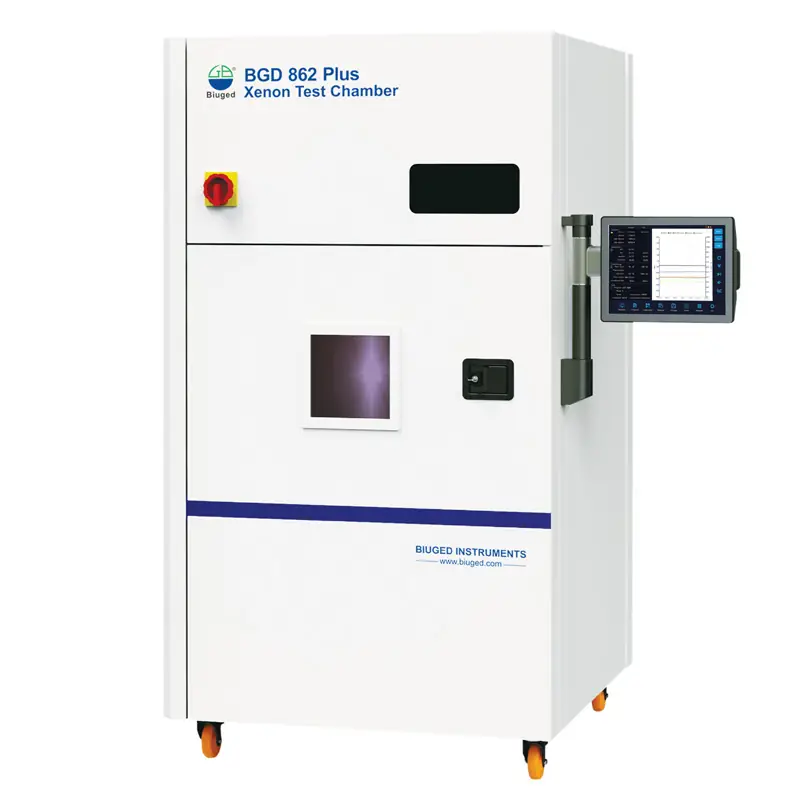
Advanced testing apparatus like the Big Xenon Test Chamber Plus integrate precise closed-loop sensors to monitor black panel values and chamber air temperatures simultaneously. Blower speeds and heating elements adjust automatically to maintain target surface temperatures within tight tolerances, preventing thermal overshoot during high-irradiance test intervals.
Uniformity Assurance and Irradiance Calibration
Irradiance uniformity across the exposure plane determines whether replicate specimens degrade at identical rates during extended qualification trials. Photodegradation rates depend directly on cumulative photon dosage absorbed at specific wavelengths. Closed-loop control systems calibrate xenon output continuously at either 340 nanometers, 420 nanometers, or across the broad 300 to 400 nanometer band.
Operating a modern xenon arc test chamber with a rotating specimen rack guarantees equalized exposure across all test samples. Specimen holders circling the central vertical water-cooled lamp eliminate localized irradiance dead zones and non-uniform airflow patterns. Rotating specimen racks help improve exposure uniformity by changing sample positions during testing. Irradiance control and periodic verification are still necessary to assess exposure consistency.
Periodic repositioning protocols within flat-tray chambers provide comparable uniformity when rotating racks are unavailable. Systematic sample rotation schedules balance minor edge-to-center irradiance differences, ensuring audit-compliant results. Routine radiometer calibration using traceable optical standards safeguards long-term measurement integrity and cross-laboratory correlation.
Standardizing Accelerated Weathering with BIUGED INSTRUMENTS
Reliable weathering programs require testing systems engineered for uncompromised optical stability and environmental control. Since 1963, BIUGED INSTRUMENTS has designed precision material testing instruments and automated quality inspection solutions for global coatings, polymer, and automotive manufacturers. Their equipment combines durable mechanical architecture with intelligent digital automation to streamline quality assurance workflows.
Engineers seeking compliant testing protocols rely on the Big Xenon Test Chamber Plus to satisfy ASTM G155, ISO 4892-2, and SAE standards. Manufactured by BIUGED INSTRUMENTS, this high-capacity system features advanced ultrasonic humidification, precise closed-loop irradiance regulation, and programmable touchscreen controls that reduce operational drift during demanding durability trials.
Selecting an advanced xenon arc test chamber ensures laboratory evaluations predict outdoor service lifetimes accurately and cost-effectively. Materials testing directors and quality assurance managers can connect with BIUGED INSTRUMENTS to configure customized weathering solutions and elevate their material durability testing programs.
